
A Practical Framework for Enabling Billable Patient Navigation at Scale
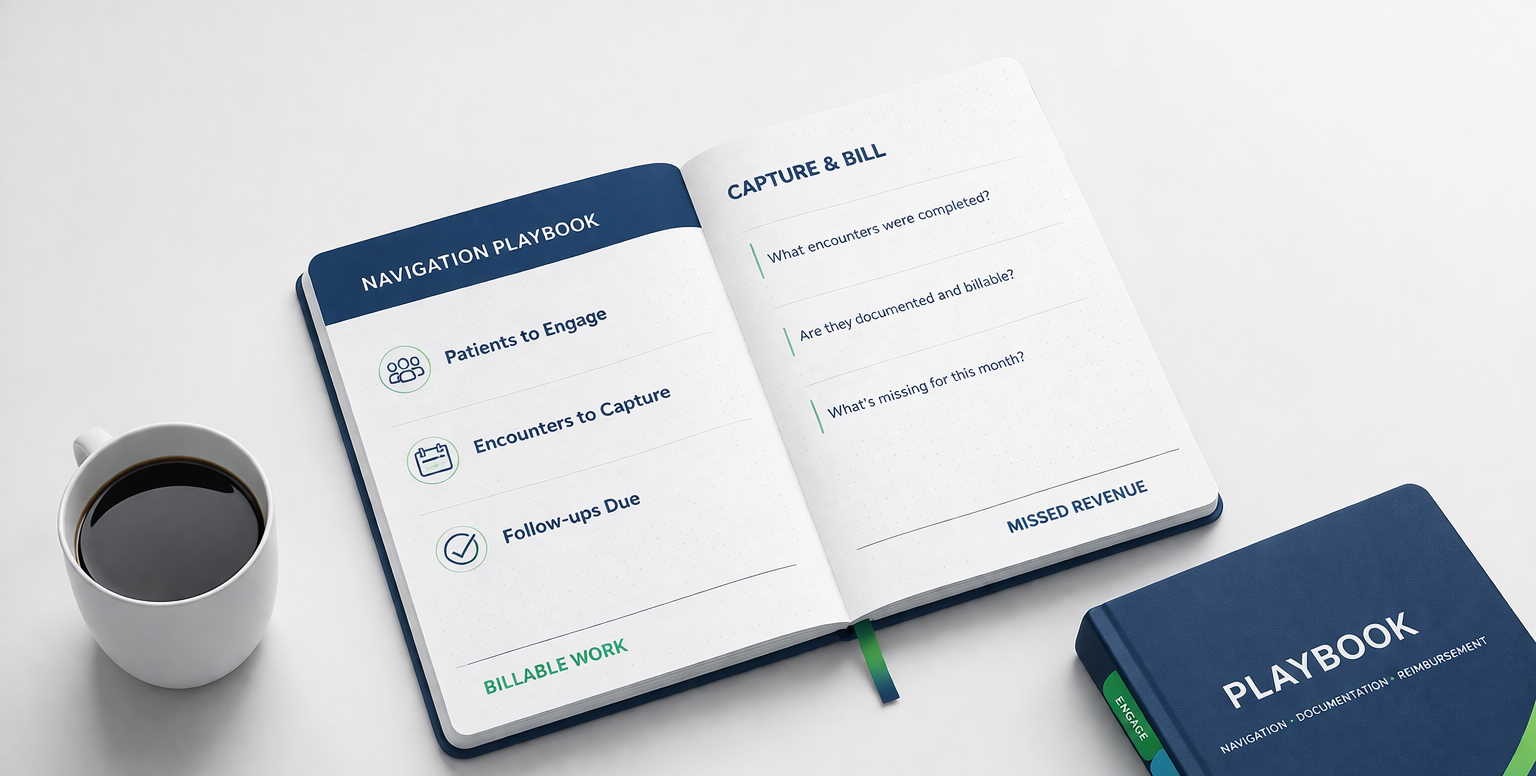
Patient navigation has become an essential part of modern oncology care.
Across surgical and radiation oncology practices, teams are already:
Coordinating appointments
Following up with patients
Addressing barriers to care
Communicating with payors and caregivers
However, in most organizations, this work remains:
Dispersed across roles
Inconsistently documented
Operationally invisible
Financially unrecovered
Unquantified and unmeasured
Recent reimbursement models, including Principal Care Management (PCM) and Patient Navigation (PIN), have introduced a structural shift. Navigation is no longer just a care coordination activity. It is now a billable, measurable, and scalable program.
The challenge is not whether practices perform navigation. The challenge is operationalizing it in a way that can be consistently billed, measured, and managed at scale. This playbook outlines the three foundational layers required to enable navigation billing: Staff, Processes, and Tools.
Before implementing, quantify the opportunity and ROI for your practice or program, based on the average hours you currently spend performing patient navigation services.. We designed a Navigation Revenue Calculator that will help you to understand:
Navigation Minutes per category
Revenue per patient
wRVUs per patient
Total program value in dollars or wRVUs
See how much revenue / wRVU you can make in a year from navigation activities with our simple Navigation Revenue Calculator.



Prepare your staff for navigation billing by clearly assigning ownership of navigation work, aligning roles to billing rules, certifying non-clinical team members, training everyone on billing fundamentals and non-standard billing scenarios, introducing dedicated navigator capacity, and reinforcing adoption through education, accountability, and incentives.
Identify all roles currently performing navigation activities:
Clinical staff (RN, MD)
Nurse Practitioners
Medical Assistants or coordinators
Existing or potential dedicated navigators
Then explicitly assign responsibility:
Who owns navigation for each patient
Who logs encounters, tracks calls, making sure that everything is properly documented
Who is accountable for completeness
Ensure roles are aligned with billing:
Clinical roles → PCM
Non-clinical roles → PIN
👉 If ownership is unclear, navigation will not be captured or billed consistently.
Enroll all non-clinical staff involved in navigation in formal training or certification. Either of these is required in order to bill for navigation. Use structured programs such as those from the American College of Surgeons: https://www.cancer.org/health-care-professionals/resources-for-professionals/patient-navigator-training.html
Certification Program benefits:
Certification allows to bill for navigation encounters
Greater credibility with the formal endorsement of your patient navigation expertise
Improved knowledge and skills of the complex cancer care system
Enhanced understanding of how to tailor support to patient needs
Preparation for greater responsibility and professional development
👉 It’s a requirement, and the knowledge obtained will help you be more efficient.
If navigation is currently distributed:
Evaluate workload and volume
Identify candidates for dedicated roles
Move toward Hybrid model → Dedicated navigation team
👉 Dedicated navigators significantly improve consistency, capture rate, and revenue.
Train all staff involved in navigation to understand:
Billable domains
PCM vs PIN
Monthly time aggregation
Why small interactions matter and they are supposed to be logged
👉 Make sure they understand that every minute not logged is revenue lost.
Since navigation billing is new, there are a lot of non-standard situations and gray zones when it comes to billing:
Encounter types that are not billable (SMS, email)
Hold time during calls, which is very common when calling insurance companies
What to do if the patient declined recording consent
Disengaged patients
👉 Make sure staff know how to handle non-standard scenarios, because missed or mismanaged scenarios lead to lost billable encounters.
Explain clearly:
Why navigation is now billable
How it impacts practice revenue
How it improves clinical outcomes
How it improves patient experience
Tie navigation to:
Financial sustainability
Reduced administrative burden (with the right tools)
Better patient flow
👉 Without clear alignment, adoption drops, and both revenue and patient impact are lost.
Introduce mechanisms to reinforce behavior:
Revenue dashboards per navigator
Performance reports
Bonus structures tied to collections or encounters
Gamification (targets, milestones)
👉 Without clear alignment, adoption drops, and both revenue and patient impact are lost.
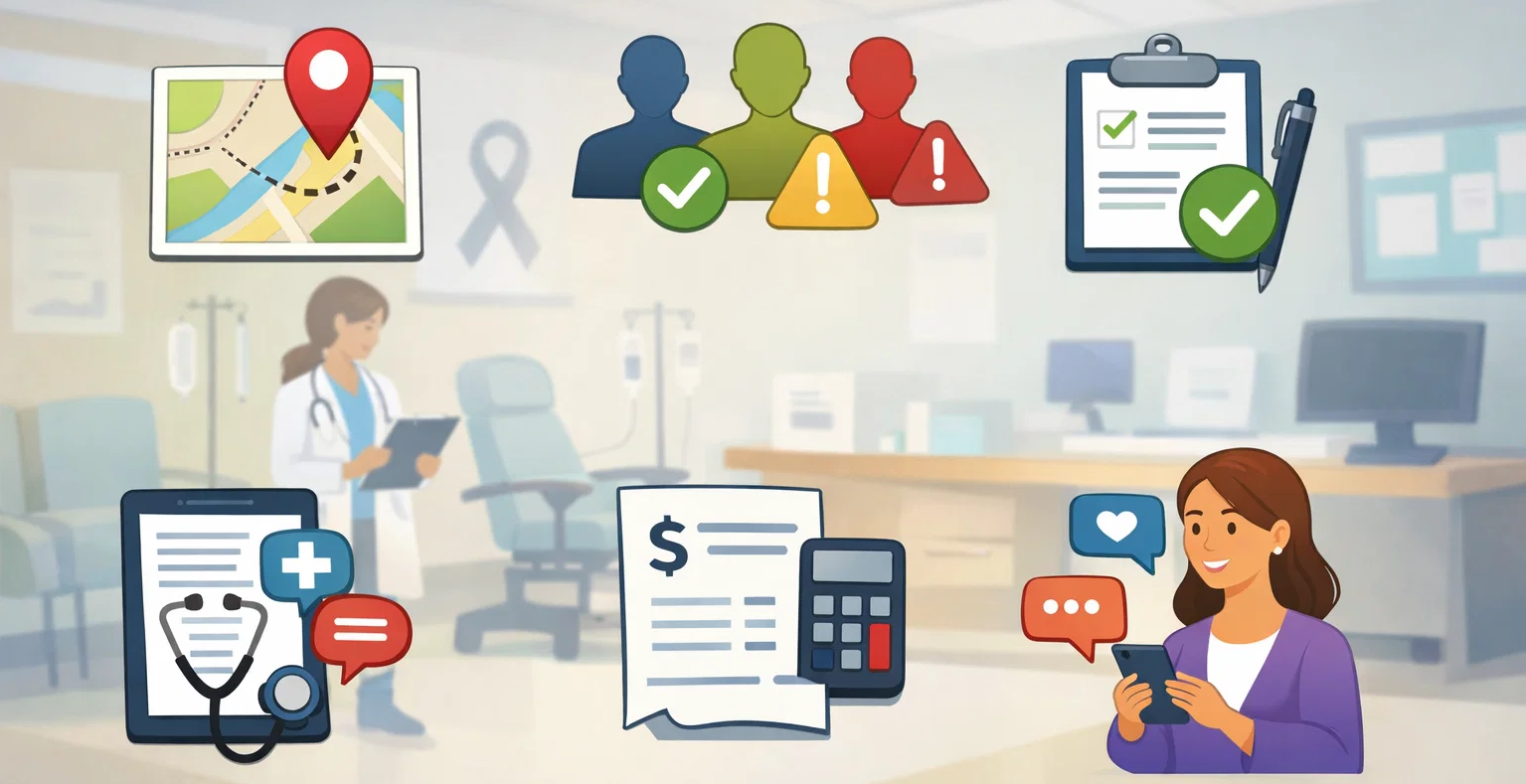
Turn navigation into a structured, billable operation by standardizing patient enrollment, risk stratification, consent capture, encounter logging, and billing workflows. The objective is to ensure navigation is consistently executed, properly tracked, and reliably converted into both clinical impact and revenue.
Make navigation initiation mandatory. Define:
When navigation starts (typically first E&M visit)
Who initiates it (physician or clinical team)
How patients are enrolled
👉 Do not leave enrollment to chance or individual discretion.
Build consent into your workflow:
Capture it early (at enrollment)
Educate patients on navigation benefits
Explain the potential copay
Track consent status and consent revocations
👉 No consent = no billing.
Define navigation intensity tiers based on:
SDoH
Cancer stage
Prior delays
Transportation barriers
Language or social challenges
Use this segmentation to:
Prioritize navigator time
Increase encounter frequency where needed
👉 Higher-risk patients generate both higher impact and higher billable activity.
Decide upfront:
Will you collect copays?
Will you waive them for individual patients?
Document your policy and apply it consistently.
👉 Designing a local policy for how to deal with patients unable to pay copays can increase patient participation and often drive higher overall revenue.
Require all navigation activities to be logged:
Calls
Chart management
Insurance interactions
Prep time and documentation time
In-person interactions
Define:
Where logging happens
When it happens (immediately after interaction or it's tracked automatically with scribing tools)
What must be included (Time spent on interaction + prep + documentation, notes, categories, codes, etc.)
👉 If logging is optional or delayed, it will not happen.
Ensure your process:
Aggregates time monthly per patient
Separates PCM vs PIN time based on role and tracks other codes if applicable
Checks patient consent
Identifies patients who meet thresholds
Everything is tracable and auditable
Coordinate with
Billing team
Billing software
👉 A clear PCM and PIN workflow prevents denials and billing delays, ensuring your navigation work is reimbursed accurately and on time.
Encourage patients to:
Call or message navigators proactively
Use designated communication channels
Ensure:
All inbound interactions are captured and logged
👉 Patient engagement increases both outcomes and billable activity.
Define and track:
Patients enrolled
Minutes logged per patient
Revenue generated
Time-to-treatment
Delay reasons
Navigator productivity and involvement
Review regularly:
Weekly (operational)
Monthly (financial + outcomes)
👉 If you don’t measure it, you can’t scale it.

Adopt a centralized navigation system that captures all activity, automates documentation and coding, tracks consent and prior authorization, and provides visibility into performance and billing readiness. The right tools reduce manual work, prevent errors and denials, and make navigation scalable and financially sustainable.
Stop relying on:
Spreadsheets
Disconnected tools
Manual tracking
Implement a system that:
Centralizes all navigation activity
Tracks encounters in one place
Aggregates time automatically
👉 Without a system, scaling is not possible.
Use tools that:
Record calls
Generate encounter summaries automatically
Reduce manual note-taking
👉 If documentation takes longer than the interaction, staff will stop logging.
Use a system that:
Maps roles to PCM vs PIN
Applies correct CPT codes
Handles primary vs. add-on CPT code logic
👉 Manual mapping leads to errors and missed revenue.
Ensure your system:
Store the consent status of each patient
Track other consents, like recording consent
Flags non-consented patients
Tracks consent status changes
👉 Prevent billing errors and compliance issues.
If required by payors:
Track PA status
Prevent billing before approval
Use templates to challenge insurance denials
👉 Prevent billing errors and compliance issues.
Monitor:
Patients near billing thresholds
Patients needing follow-up
Gaps in encounter capture
Patient experiencing delays in care
👉 This is where incremental revenue is unlocked.
Measure:
Process adoption by navigators
Revenue per navigator
Encounters per patient
Time-to-treatment
Delay reduction
👉 Navigation must prove both financial and clinical impact.
Use tools that:
Schedule activities
Set reminders
Escalate delays
👉 Navigation is coordination. Without task management, things fall through.
Minimize duplication:
Integrate with EHR and practice management where possible
Or streamline workflows across systems
Avoid double documentation at all costs
👉 Double documentation reduces adoption and ROI.
To successfully bill for navigation, you must:
Define ownership (Staff)
Standardize execution (Processes)
Implement infrastructure (Tools)
Missing any one of these will result in:
Lost revenue
Low adoption
Operational failure
When implemented correctly, navigation becomes:
A structured program
A measurable system
A sustainable revenue stream
XpediteMD provides the technical infrastructure required to execute this playbook:
Centralized navigation workflows
Automated encounter capture and documentation
PCM / PIN code mapping
Consent and compliance tracking
Activity scheduling and reminders
Time-to-treatment tracking and delays
Billing documentation generation
Real-time operational and financial dashboards
And see the XpediteMD Cancer Patient Navigation
Platform in Action

.svg)
.svg)

See how much revenue / wRVU you can make a year from navigation activities with our simple Navigation Revenue Calculator.
Estimate My Revenue