

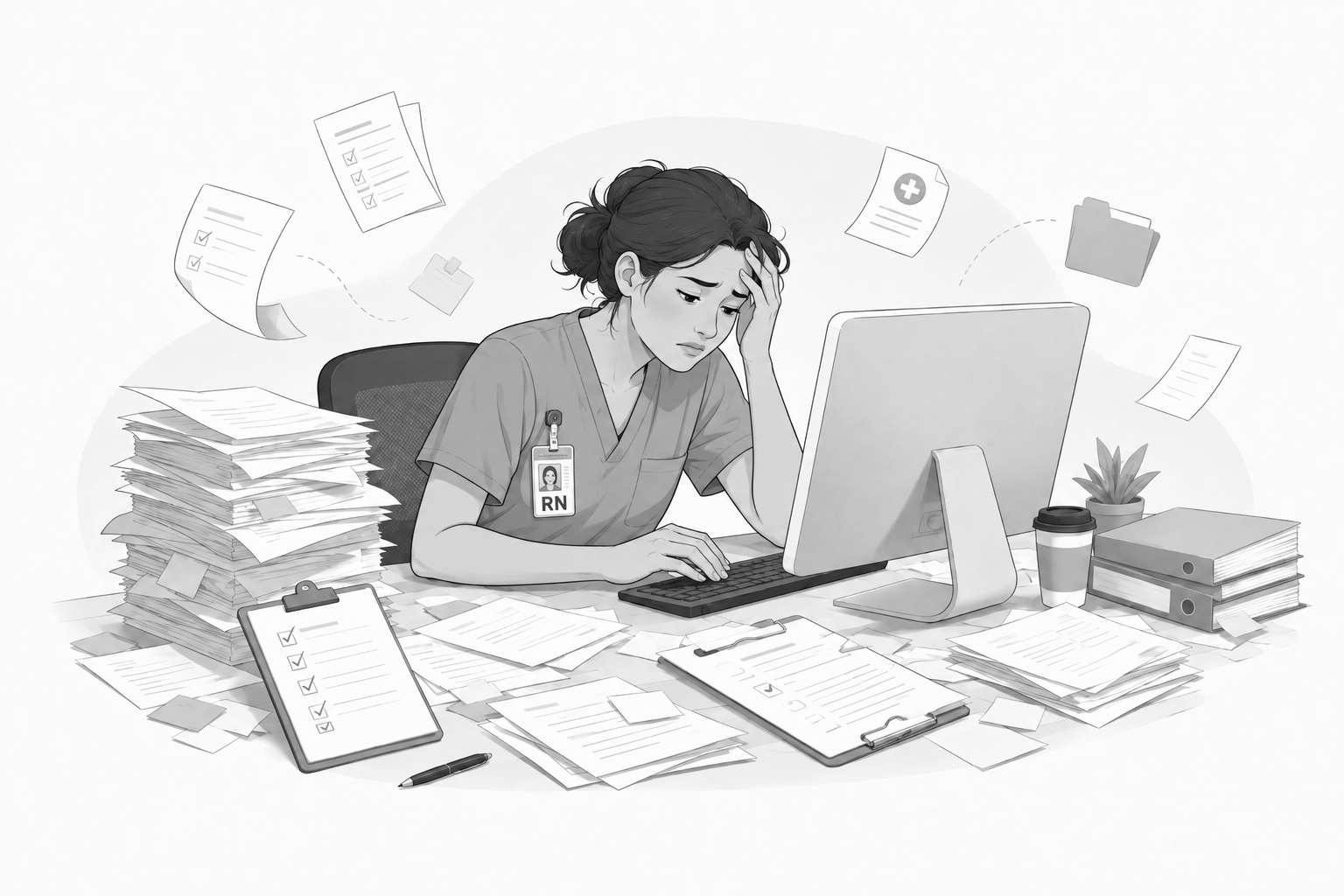
There is a version of oncology navigation that most people outside the role don't see.
It is not the version that happens on the phone with a frightened patient, or in the moment when a barrier gets resolved before it becomes a crisis. It is the version that happens after — the hour spent reconstructing a call into a note, the 20 minutes tracking down an authorization status that should have been visible from the start, the end of a day that was supposed to be about patients but ended with a backlog of documentation that won't clear itself.
This is the documentation trap. And it is quietly eroding one of the most important professions in oncology.
What the Time Actually Goes To
Research from AONN+ and related navigator surveys consistently finds that oncology navigators spend between 30 and 40 percent of their working day on administrative documentation — not patient contact, not care coordination, not the clinical judgment that their training prepared them for.
That is not a rounding error. For a full-time navigator managing 80 active patients, it represents roughly 12 to 16 hours per week spent not being present for the people they entered this work to support.
What fills that time? Reconstructing phone conversations into encounter notes. Manually updating tracking spreadsheets. Logging touchpoints across systems that were not built to talk to each other. Re-entering information that already exists in one place into another place that needs it separately. Documenting barriers that were resolved hours ago, under time pressure, from memory, at the end of a shift.
None of this is what navigators are trained for. Almost all of it could be structured differently.
The Cascade Effect
The documentation burden doesn't stay contained to the navigator's schedule. It spreads.
Fewer patients seen. A navigator spending a third of her day on admin is seeing a third fewer patients than she could. That is not a staffing problem. It is a workflow problem — but the impact lands on patients.
Burnout and attrition. Navigators are among the most mission-driven professionals in healthcare. They entered this work because they wanted to be present for patients during one of the hardest experiences of those patients' lives. When the job becomes primarily administrative, the disconnect between motivation and daily reality accumulates. The burnout rate in navigation is not incidental. It is structural.
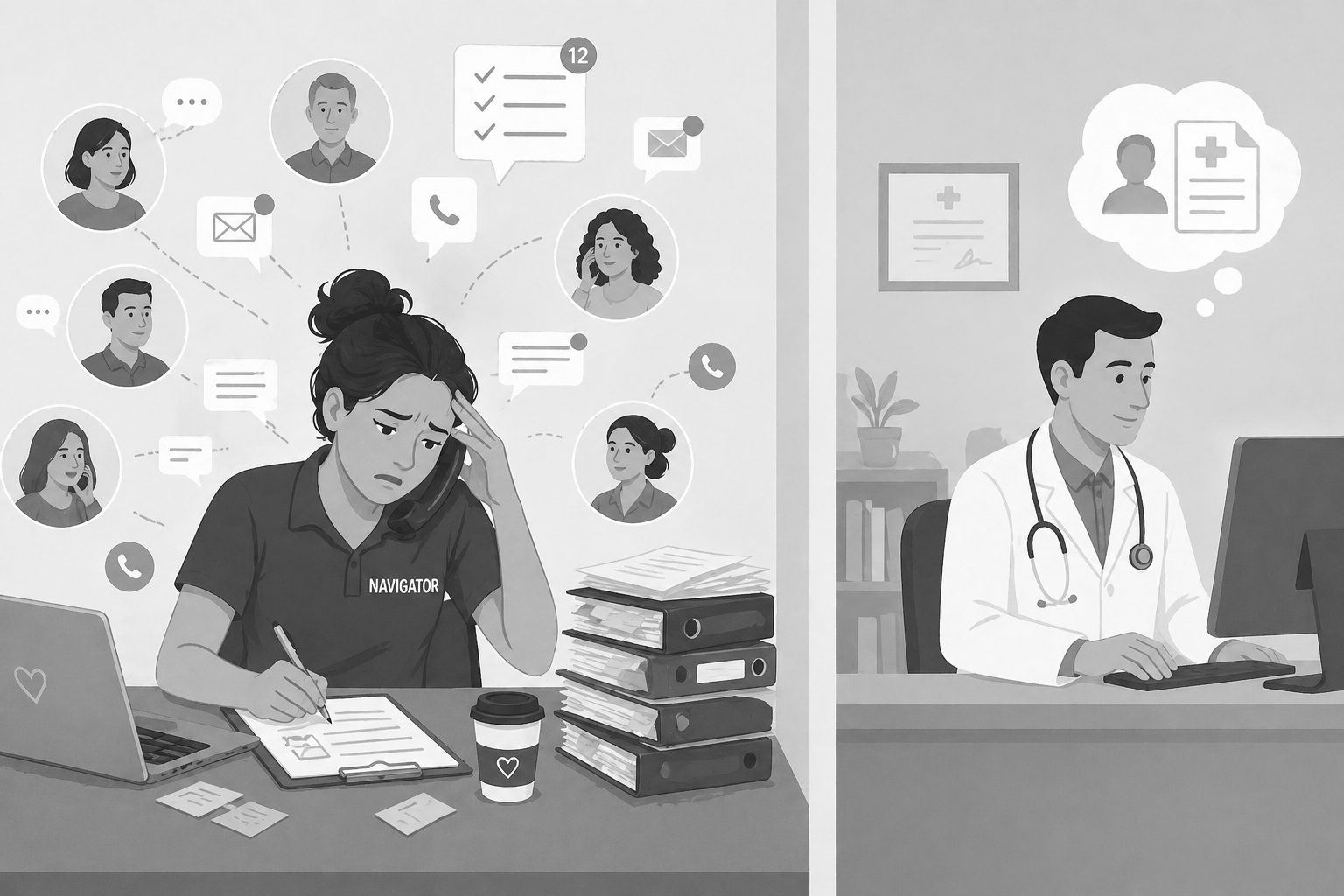
Program vulnerability. When a navigator leaves, they take institutional knowledge that often exists nowhere else — which patients are struggling, what barriers were in progress, where follow-up was pending. If the documentation system is informal or fragmented, that knowledge leaves with them. Programs that depend on individual memory rather than structured records are fragile by design.
Invisible impact. Documentation burden is also one of the primary reasons navigation work stays invisible. When there is no structured record of what a navigator did this week — touchpoints, barriers resolved, time spent, referrals coordinated — there is no report to bring to a CMO or a program director. The work that was supposed to justify the program's existence doesn't get captured, and the program that can't show its value is the program that gets cut when budgets tighten.
What "Fixed" Documentation Actually Looks Like
Fixing documentation is not about adding another field to fill out or another system to log into. Programs that try to solve this by adding structure without reducing friction make the problem worse.
What it actually requires is shifting when and how documentation happens — from after the work to during it.
Ambient scribing means the navigator opens the patient record and calls from within the platform. The conversation is transcribed in real time and summarized automatically. When the call ends, a structured note is already drafted — with time captured, key points extracted, and next actions identified. The navigator reviews and confirms. The documentation is finished before the next patient comes up in the queue.
Auto-logging touchpoints means that every outbound call, every follow-up task, every barrier flagged is recorded as it happens — not reconstructed at the end of the day from memory. The record builds itself as the work occurs.
Structured templates replace blank text fields with guided inputs that capture what billing and reporting systems actually need — without asking the navigator to think about billing logic while she's in the middle of a patient conversation.
The cumulative effect is not small. When documentation is integrated into the workflow rather than appended to it, navigators report getting back several hours per day. That is time that goes somewhere. In practices that have made this shift, it goes back to patients.
What Navigators Do With the Time Back
The answer varies, but the pattern is consistent: more patient contact, more proactive outreach, more capacity to take on additional cases.
A navigator who spends two fewer hours a day on documentation can manage a meaningfully larger active panel. She can make the check-in call she was going to skip because the day ran long. She can catch the barrier that was developing before it became a crisis. She can be present — which is, in almost every navigator's account of why she entered this profession, the whole point.
The financial case for this is real. The clinical case is clearer.
A navigator who is less burned out sees more patients. More patients seen means better outcomes, fewer delays, more complete care. The data connecting active navigation to time-to-treatment reduction, barrier resolution rates, and patient adherence is well established.
But the prerequisite for any of that is a navigator whose day isn't being consumed by a documentation system that wasn't built for her.
A Different Standard
Navigation tools have historically been adapted from general healthcare software — EHR modules, spreadsheet templates, generic task managers — none of which were designed with the navigation workflow in mind. The result is a profession doing sophisticated, high-stakes clinical work in systems that treat documentation as an afterthought.
XpediteMD is built around a different premise: that the navigator's time is the most valuable resource in the workflow, and that every minute she spends on documentation that a system could handle is a minute she is not spending on the work that no system can replace.
Documentation should follow the navigator. Not the other way around.
XpediteMD is an oncology patient navigation platform built for navigators, providers, and the programs that support them. Request a demo to see how ambient scribing and structured workflows change what a navigator's day looks like.




.svg)
.svg)
